
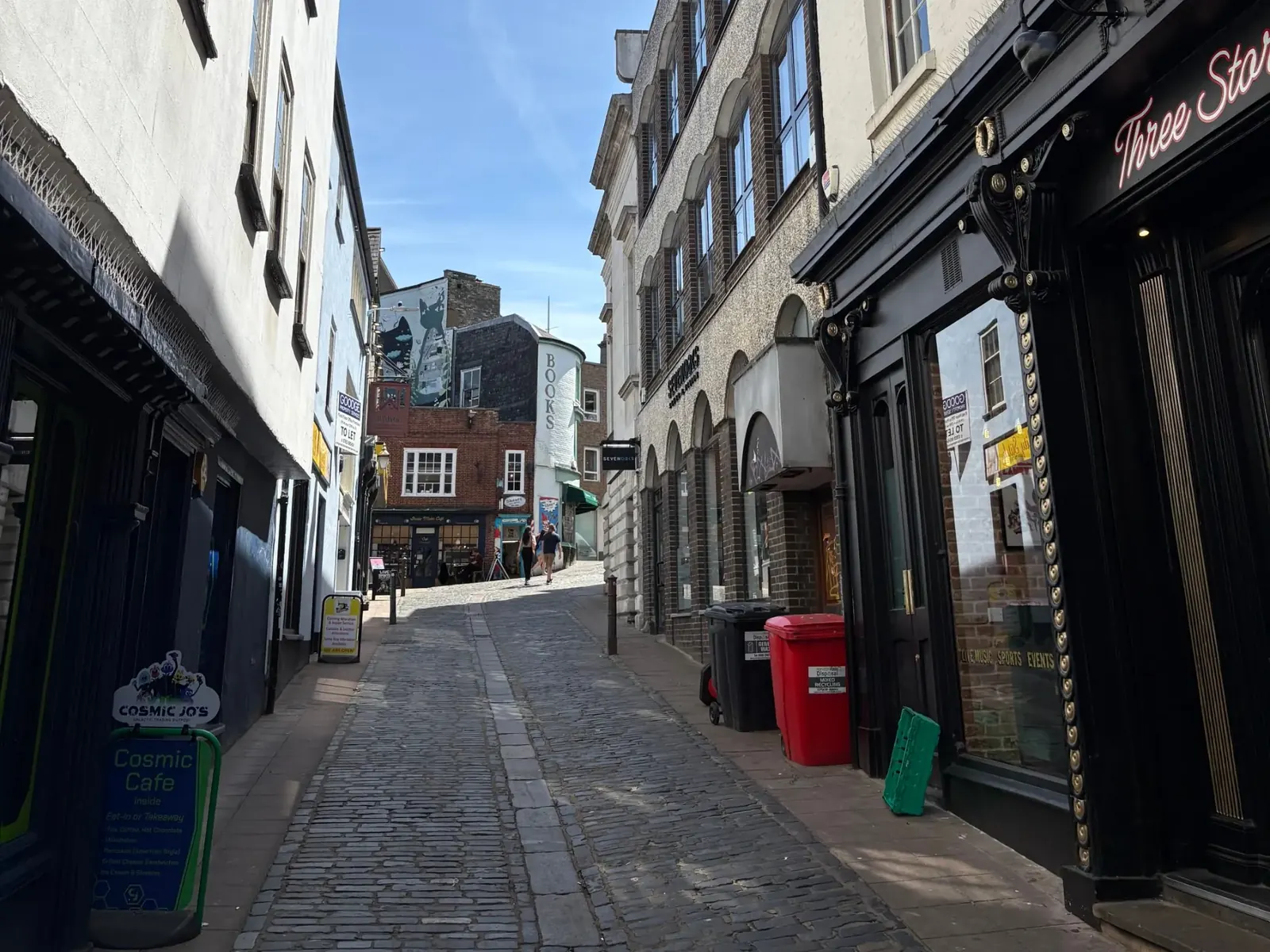
Empty units above high street shops, and offices without demand: across Norfolk and Suffolk there are plenty of commercial buildings which may offer exciting opportunities for conversion to residential use.
Class MA permitted development rights can allow that change without a full planning application. But whether Class MA works for a particular building depends heavily on where it is, what it has been used for and whether any restrictions apply.
Norwich has an Article 4 Direction removing Class MA rights from specified office buildings in parts of the city centre. Class MA also cannot be used on listed buildings, within the Broads or National Landscapes, or on certain other protected sites, with additional requirements also applying in conservation areas.
Historic centres such as Norwich, King's Lynn, Bury St Edmunds and Woodbridge therefore need particularly careful checking before relying on permitted development rights.
Quick answer
A shop, office or other Class E building in Norfolk or Suffolk can usually become homes under Class MA if it has been in Class E use for at least two continuous years, is not listed, is not in the Broads, a National Landscape or another excluded area, and is not an office covered by Norwich's Article 4 Direction. Prior approval from the council is still needed before work starts.
This guide explains when a shop or office in Norfolk or Suffolk can become homes under Class MA, where the right cannot be used, and what the alternatives may be.
What is Class MA?
Class MA is a permitted development right contained in Schedule 2, Part 3 of the General Permitted Development Order.
It allows the change of use of a building and land within its curtilage from Use Class E (commercial, business and service) to Use Class C3 dwellinghouses.
Class E is broad. It includes uses such as:
- shops
- offices
- cafés and restaurants
- banks and estate agents
- gyms
- clinics
- nurseries
- certain light industrial uses
Many buildings on a typical Norfolk or Suffolk high street therefore potentially fall within Class MA. For a fuller explanation of what sits within the use class, see our guide to understanding Use Class E for high street businesses.
Before carrying out the change of use, an application for prior approval must be made to the local planning authority.
The principle of changing qualifying Class E premises to residential use is granted nationally through the GPDO. The council's consideration is therefore restricted to whether the proposal satisfies the requirements of Class MA and the specific matters which are subject to prior approval, rather than the full range of planning considerations which would apply to a normal planning application. This avoids the need to demonstrate a lack of demand for the commercial unit.
The rules changed in March 2024
If you considered Class MA several years ago and ruled it out, it may be worth looking again.
Changes which came into force on 5 March 2024 significantly widened the right. Through the Town and Country Planning (General Permitted Development etc.) (England) (Amendment) Order 2024, the Government removed:
- the requirement for the building to have been vacant for at least three months before the prior approval application; and
- the previous 1,500 square metre floorspace limit.
This means occupied commercial premises can now qualify and there is no longer a Class MA floorspace ceiling.
The two-year use requirement still applies
One important qualifying requirement remains. The building must have been within one or more qualifying Class E uses for a continuous period of at least two years immediately before the prior approval application.
Where the use history is unclear, evidence should be gathered early. This might include:
- leases
- business rates records
- tenancy records
- Companies House or trading records
- dated photographs
- invoices and utility information
In some cases, particularly where the lawful use is uncertain, obtaining a Lawful Development Certificate before progressing the Class MA application may be sensible.
Article 4 Directions: where Class MA has been switched off
Local planning authorities can remove particular permitted development rights within defined areas using an Article 4 Direction.
Where an Article 4 Direction removes Class MA from a property, the national permitted development right cannot be relied upon and a full planning application will normally be required instead.
This is particularly important in Norwich.
Norwich
Norwich City Council has an Article 4 Direction removing Class MA rights from specified office buildings within defined parts of the city centre.
The Norwich Direction does not simply remove Class MA from every Class E premises across the city centre. It was made specifically in relation to office use falling within Class E(g)(i). Areas subject to this designation are mapped on the Norwich City Council website, and could be subject to change through subsequent Article 4 Directions. The Direction in force reflects a modification notice dated 10 February 2023.
An office within the affected area will generally require full planning permission before it can be converted to residential use. But a commercial property outside the mapped area may still benefit from Class MA, subject to the normal requirements.
Check the exact building against the Article 4 map, rather than assuming the whole of central Norwich is affected.
Dan Malloy MRTPI, Cedar PlanningWhere Class MA has been removed, the council can consider matters which would not ordinarily form part of a Class MA prior approval application, including the principle of losing the office use and relevant development plan policies protecting employment floorspace. If you have an office in the city, our planning consultant in Norwich page explains how we can help.
Converting a commercial building in Norfolk or Suffolk?
We check Article 4 Directions, designations, listing and use history before you buy, commission drawings or apply, then prepare the prior approval application on a fixed fee.
View our Class MA serviceAre there other Class MA Article 4 Directions in Norfolk or Suffolk?
At the time of writing in October 2026, we have not identified any other Article 4 Directions in Norfolk or Suffolk which remove Class MA commercial-to-residential permitted development rights.
There are, however, numerous other Article 4 Directions across the two counties. These include controls relating to:
- conversion of homes to Houses in Multiple Occupation
- alterations to houses within conservation areas
- replacement windows and doors
- other locally specific permitted development rights
For example, HMO Article 4 Directions exist in parts of Ipswich and Great Yarmouth, among other locations. Those directions do not, by themselves, prevent reliance on Class MA. Our guide to HMO Article 4 Directions explains how they work.
Because Article 4 Directions can be introduced or amended over time, the current position should always be checked with the relevant council before purchasing a property or relying on Class MA.
Where Class MA cannot be used in Norfolk and Suffolk
Quite apart from Article 4 Directions, Class MA contains a number of national exclusions. The right cannot be used where the building or site falls within certain protected designations. These include:
- the Broads
- National Landscapes (formerly Areas of Outstanding Natural Beauty)
- National Parks
- World Heritage Sites
- Sites of Special Scientific Interest
- listed buildings
- land within the curtilage of a listed building
- scheduled monuments
- safety hazard areas
- military explosives storage areas
The Broads
The Broads designation covers substantial areas of Norfolk and north Suffolk. Locations within this designation are automatically excluded from Class MA and will need to rely on full planning permission. See our page on planning in the Broads for how applications there are handled.
National Landscapes
The region also includes several National Landscapes, including:
- Norfolk Coast National Landscape
- Suffolk and Essex Coast and Heaths National Landscape
- Dedham Vale National Landscape
Locations along the north Norfolk and Suffolk coasts therefore need particular care.
Listed buildings
Class MA cannot be used where the building is listed or within the curtilage of a listed building.
This can be a factor in historic centres such as Norwich, King's Lynn, Bury St Edmunds, Lavenham and Beccles, where many commercial buildings are listed. However, as we explore below, Class G could be an opportunity.
Listed buildings: could Class G be an alternative?
The fact that Class MA is unavailable does not necessarily mean that permitted development rights are irrelevant. One alternative worth considering is Class G.
Class G can allow a building in Class E use to change to a mixed use comprising:
- a continuing Class E commercial use; and
- up to two flats.
In practical terms, this can sometimes allow upper floors above a shop, office or other commercial premises to become residential while retaining the commercial use within part of the building.
Class G is subject to its own detailed limitations and prior approval requirements, so it should be considered separately rather than treated as a substitute version of Class MA.
Where the building is listed, listed building consent may also be required for physical works affecting its special architectural or historic interest, even where the change of use itself benefits from permitted development rights.
Read more: Class G permitted development: a solution for mixed-use and listed buildings.
Conservation areas do not automatically prevent Class MA
A conservation area designation does not automatically remove Class MA rights. That distinction is important because many Norfolk and Suffolk town centres are conservation areas.
However, Class MA contains an additional prior approval matter where the building is:
- within a conservation area; and
- the proposal involves the change of use of all or part of the ground floor.
In those circumstances, the council can consider the impact of the proposed change of use on the character or sustainability of the conservation area.
This can be significant for high street properties. A proposal to convert an active ground-floor shop into flats within a historic town centre is likely to attract more scrutiny than the conversion of upper-floor office accommodation or a less prominent commercial building.
Applications are generally stronger where they properly explain:
- how the building currently contributes to the conservation area
- what effect the change of use would have
- the commercial history of the premises, where relevant
- how the ground-floor frontage will function
- the treatment of entrances, windows and bin storage
- whether an active commercial frontage can be retained
Another option may be to retain the commercial use at ground-floor level and convert only upper floors, depending on the circumstances of the building.
Separate planning permission may still be required for operational development such as substantial alterations to shopfronts, new windows or other external works. Where heritage impact needs to be set out, we prepare heritage statements in Norfolk and across the wider region.
What else can the council consider under Class MA?
Class MA prior approval applications are assessed against a defined list of matters. These include:
Transport
The council can consider transport impacts, particularly whether the development provides safe access to and from the site.
Contamination
This can be important where commercial premises have previously been used as workshops, garages or for other activities which may have contaminated the land or building.
Flooding
Flood risk is particularly important in parts of Great Yarmouth, King's Lynn, Lowestoft and along the region's rivers and coast. Depending on the site, a Flood Risk Assessment may be required, and safe access and egress during flooding events will need to be demonstrated.
Noise from commercial premises
The council can consider the effect of noise from surrounding commercial premises on future residents. This can be particularly relevant where homes are proposed close to:
- pubs
- restaurants
- takeaways
- entertainment venues
- workshops
- commercial plant
Natural light
Adequate natural light must be provided to all habitable rooms. This can be one of the biggest constraints when converting deep-plan offices and shops where large areas of floorspace are some distance from external windows.
Heavy industry, waste management and storage or distribution
Additional consideration applies where the site is located within an area important for certain industrial, waste or storage and distribution uses. The issue is the impact of introducing residential occupiers into those areas.
Registered nurseries and health centres
The council can consider the impact of losing certain registered nurseries and health centres.
Fire safety
Additional fire safety prior approval requirements apply to certain taller buildings.
Minimum space standards
Homes created through Class MA must comply with the nationally described space standards. This should be checked at an early stage.
A building may have enough overall floorspace to provide several flats but still be incapable of producing compliant units once issues such as bedrooms, circulation space, natural light, internal layouts and refuse storage are taken into account.
You can test a layout quickly with our minimum space standards calculator.
How long do you have to complete the conversion?
Development permitted under Class MA must generally be completed within three years from the date prior approval is granted. That is worth factoring into acquisition and development programmes, particularly on larger conversion schemes.
Is Class MA right for your building?
Class MA can provide a valuable route for converting redundant or underused commercial buildings into homes without having to establish the principle of residential development through a full planning application.
But it should never be assumed to apply simply because a building is a shop or office. At Cedar Planning, we assess Class MA eligibility before clients purchase buildings, commission detailed drawings or submit applications.
We prepare prior approval submissions across Norfolk and Suffolk and, where Class MA is unavailable, advise on alternatives including Class G or a full planning application. Find out more about our Class MA prior approval service, or see how we secured Class MA prior approval for an office-to-residential conversion and a Class MA approval in Camden.
Class MA help across Norfolk and Suffolk
Norwich · King's Lynn & West Norfolk · Great Yarmouth · Breckland · South Norfolk · North Norfolk · Broadland · Ipswich · West Suffolk · East Suffolk · Babergh · Mid Suffolk
Contact Cedar Planning to discuss your building, message us on WhatsApp, call 01603 575714, or book a free 15-minute telephone consultation.
Request a Class MA eligibility check
Send us the address and a short description of the building. We'll check Article 4 Directions, designations, listing, use history and space standards, and confirm a fixed fee before any work starts.
Request a fixed-fee eligibility check
Dan Malloy MRTPIDirector and Chartered Town Planner at Cedar Planning, with more than ten years of public and private-sector planning experience. About Cedar Planning