
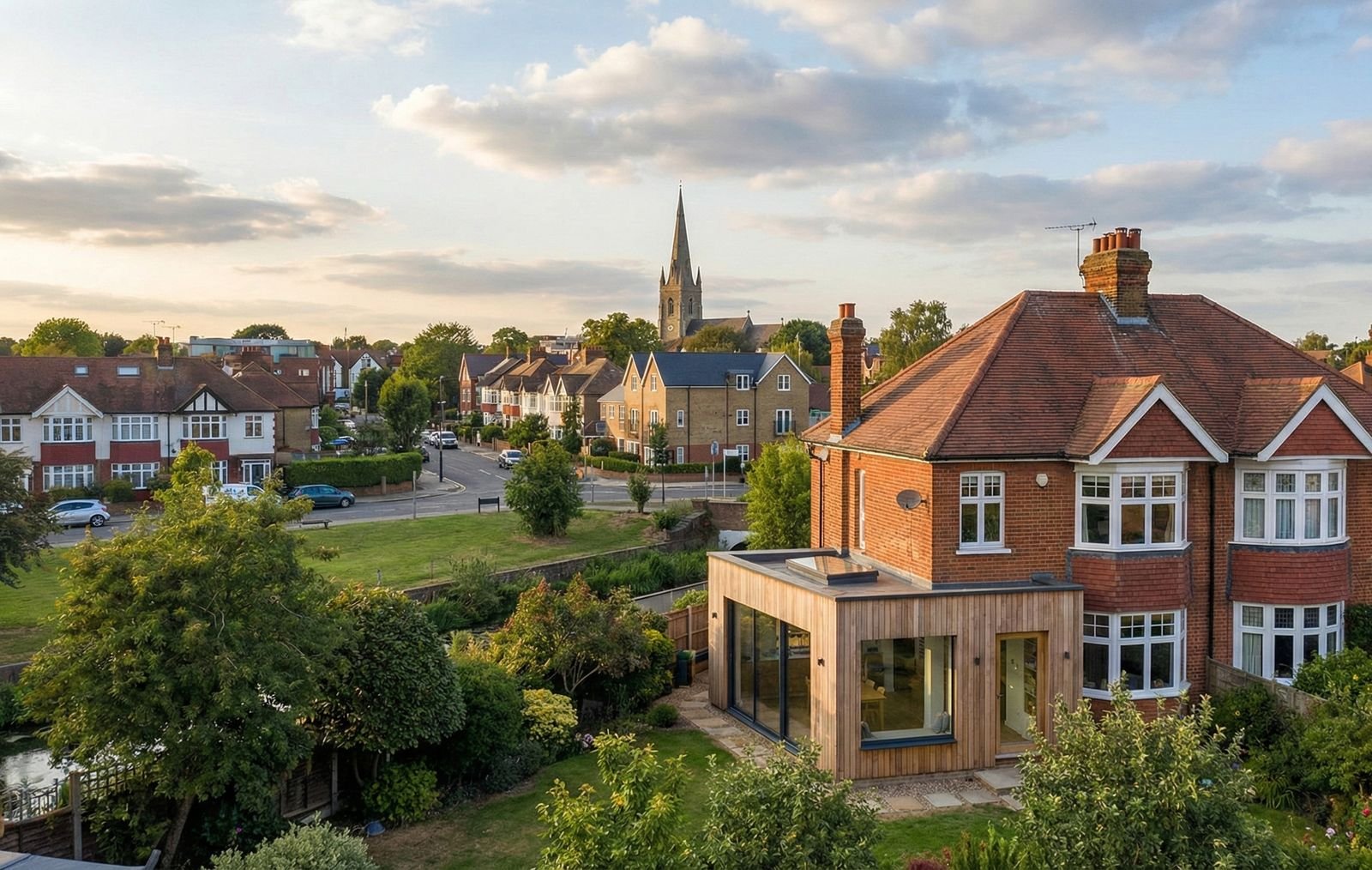
Policy S4 of the new NPPF introduces clear national support for development within settlements. This could create opportunities for landowners, developers and homeowners with sites that might previously have struggled against restrictive local planning policies.
The new National Planning Policy Framework (NPPF), published on 17 August 2026, introduces a fundamentally different approach to deciding whether development is acceptable in principle. At the centre of this is Policy S4: Principle of development within settlements.
For sites located within a settlement, the starting point is now that development proposals should be approved unless the benefits are substantially outweighed by adverse effects, when considered against the other national decision-making policies in the NPPF.
That does not mean that every piece of land within a settlement is automatically developable, and there are some important caveats.
What does NPPF Policy S3 say?
Before looking at the detail of Policy S4, we need to work backwards and understand Policy S3 of the new NPPF. Policy S3 states that planning decisions should apply a presumption in favour of sustainable development. When considering development proposals within settlements, Policy S4 applies. As such, a proposal which complies with Policy S4 is sustainable development by definition.
What does NPPF Policy S4 say?
Policy S4 establishes the principle that development within settlements should generally be approved unless its adverse effects substantially outweigh the benefits. This forms part of the new NPPF's wider presumption in favour of sustainable development, and it gives the location of a site much greater importance at the outset of a planning assessment.
If your land falls within a settlement, S4 may provide significant national policy support for development in principle.
The Government's consultation leading to the new Framework made clear that the intention was to move beyond support only for brownfield sites and establish a more comprehensive approach to suitable development within settlements. It expressly recognised that some non-brownfield land within settlements may also be appropriate for development, including relatively small sites and, potentially, residential curtilages.
That creates potentially important opportunities for development which may previously have been refused.
Does being inside a settlement boundary now mean I can build?
No, not automatically.
Whilst Policy S4 may strengthen the policy position for new development within settlements, a site within a settlement may still face significant constraints. These could include, but are not limited to:
- harmful effects on neighbouring properties
- poor access or highway safety
- flood risk (see our sequential test service)
- heritage impacts (see heritage statements)
- ecology
- protected open space
- trees
- unsuitable design or scale
- insufficient parking
- the loss of a particular allocated or protected land use
- other national planning policies which weigh against development
If the harm arising from any of these considerations is significant enough to outweigh the benefits, planning permission may still be refused.
Part c. of Policy S4 also advises that where development fails to comply with one of the national decision-making policies which state that proposals should be refused, the benefits of approving the development may be substantially outweighed by adverse impacts.
Could this help small residential development?
Potentially, yes. One of the areas where Policy S4 could become particularly important is small-site residential development.
Across Norfolk, Suffolk, Cambridgeshire, Essex and elsewhere, we regularly see land within or surrounded by existing settlements that has development potential but does not fall into an obvious Local Plan housing allocation. Examples might include:
- a large side garden
- land behind an existing house
- an underused commercial site
- a garage or storage area
- redundant buildings
- an unusually large residential plot
- a gap between existing houses
- an awkward piece of previously developed land
- land on the edge of, but still within, a defined settlement
What is a settlement?
Whether a site lies within a settlement may be fairly obvious in many cases. In others, it is likely to lead to disagreement. The NPPF makes 46 references to the term settlement, with the glossary defining it as:
"Includes cities, towns, villages and other predominantly built-up areas, including land which is allocated or has permission for development which will form part of the built-up area once the development is complete. This includes areas defined as a settlement in the development plan (whether using defined settlement boundaries or equivalent terms, or criteria for identifying settlement extents where boundaries have yet to be defined). Settlements do not include hamlets and scattered groups of houses located outside predominantly built-up areas, unless specifically defined as a settlement in the development plan. For the purpose of this Framework they also exclude villages which lie within and are defined as part of the Green Belt in the development plan."
National Planning Policy Framework (2026), Annex: Glossary
Whether a site is inside or outside a settlement is likely to be a key factor in many cases. Policy S4 applies to development within settlements, where there is a strong presumption in favour of development. Policy S5 provides some opportunities for development outside settlements, but only in the circumstances set out within that policy. Our recent post on rural development opportunities in the new NPPF explains Policy S5 in more detail.
Because the definition says "This includes…", a site does not necessarily need to be within a defined settlement boundary. Indeed, in a recent appeal at Eastbourne Road, Polegate, in Wealden, the Inspector allowed the appeal partly on this basis. The Inspector found that the site, whilst outside the settlement boundary, formed part of the settlement because it had existing development on three sides and a recent development on the fourth.
In this context, Policy S3 states that different policies apply to different parts of a development which is partly within and partly outside a settlement. The application of this part of Policy S3 may prove problematic in practice.
Hamlets and groups of houses outside predominantly built-up areas are also excluded from Policy S4, unless they are defined as a settlement in the development plan. Many rural areas have numerous small hamlets and clusters of houses, so clear settlement boundaries or criteria for what counts as a settlement are likely to be welcomed in these areas. Villages washed over by the Green Belt are excluded too; our guide to grey belt land covers the separate Green Belt tests.
Can I build a house in my garden under Policy S4?
Policy S4 introduces the potential for new development opportunities within settlements which may previously have been refused. A large garden can look like an obvious development opportunity, particularly where it sits inside an established village or urban area.
Policy S4 could strengthen the case for development within residential areas, but the fact that land forms part of a garden does not automatically make it suitable for another dwelling. The detailed assessment is likely to include:
- the character and pattern of development
- access
- neighbouring amenity
- plot size and amenity space
- design
However, the starting point has been significantly strengthened for development in these circumstances.
Policy L2 of the NPPF is also likely to help promoters of garden land development. It states that substantial weight should be given to the benefits where a development proposal would create additional homes within existing plots and at least 50% of the undeveloped area is retained. Development beyond this may still be possible where it would not harm the overall character of the area.
Coming soon
We will look at garden development in more detail in a separate guide. The key point is that Policy S4 may strengthen the starting position without removing the need for a well-designed scheme. See our householder planning and planning application services.
What about brownfield land within settlements?
The previous NPPF already contained strong support for using suitable brownfield land within settlements. The new approach goes further by placing that principle within a wider policy framework supporting development across settlements as a whole, rather than limiting the favourable starting point to previously developed land. The Government described this as providing greater certainty for those bringing forward development, including smaller sites.
For a brownfield site inside a settlement, therefore, there may be several layers of policy support. Typical opportunities might include:
- redevelopment of workshops or yards
- replacement of underused commercial buildings (some may also qualify for Class MA prior approval)
- redevelopment of former community buildings
- conversion and redevelopment of existing structures
- infill around existing development
- more efficient use of low-density developed sites
However, Policy S4 2(a)(i) states that the allocation or safeguarding of land or buildings for particular uses in the development plan could prevent redevelopment. In those circumstances, evidence of a lack of demand for the existing use is likely to be important. Whether residential development is ultimately acceptable will still depend on matters such as the existing land use, neighbouring uses, highways, contamination, flood risk and design.
But the principle of making more effective use of suitable land within settlements is now firmly embedded within national policy.
Could a site previously considered unsuitable now be worth looking at again?
Potentially. The new NPPF provides a fresh policy baseline against which to assess your proposal.
Changes to national planning policy do not mean every previously refused site will suddenly receive permission. But where a site was previously discounted mainly because of a restrictive policy approach to development within a settlement, it may be worth reconsidering. If you have a recent refusal, our guide to what to do after a planning refusal sets out the options, including a revised application or a planning appeal.
At Cedar Planning, our feasibility studies assess your proposal against all relevant local and national planning policy. Where there is a history of refusals, a feasibility study is often the recommended first step to understand the main constraints and planning risks, and to build a strategy to overcome them.
What should landowners and developers do now?
The publication of the new NPPF does not mean that every site inside a village or town should immediately be submitted as a planning application. It does mean there is good reason to reassess land within settlements that may previously have been overlooked.
Before spending significant sums on architectural drawings and technical reports, we would normally recommend establishing the planning position first. A desktop site appraisal can consider:
- whether the site is within a settlement
- the relevant Local Plan policies
- Policy S4 and other applicable NPPF policies
- the site's planning history
- nearby planning decisions
- environmental and heritage constraints
- access and highways issues
- likely development capacity
- the most appropriate planning strategy
That allows the main planning risks to be understood before committing significant time or expense to application fees, technical reports and planning drawings. Our guide on how to assess whether a site is developable explains the process in more detail. For larger sites that sit just outside a settlement, promotion through the Local Plan may be the better route.
Could your land have development potential?
Cedar Planning provides independent planning advice to homeowners, landowners and developers across England, with particular experience throughout Norfolk, Suffolk, Cambridgeshire and Essex.
If you have land within or close to a settlement and want to understand whether the new NPPF improves its development prospects, we can carry out an initial planning site appraisal before you commit to a full planning application. We review the policy position, site constraints, planning history and likely planning strategy, and give clear advice on the opportunities and risks.
Contact Cedar Planning to discuss your site or request an initial planning appraisal, or book a free 15-minute telephone consultation.

Dan Malloy MRTPIDirector and Chartered Town Planner at Cedar Planning, with more than ten years of public and private-sector planning experience. About Cedar Planning